
Girls' Frontline 2 Combat, Cover, and Tiles
Why shots never miss, how Stability actually works, and what Chiral Redundancy changed on the grid.
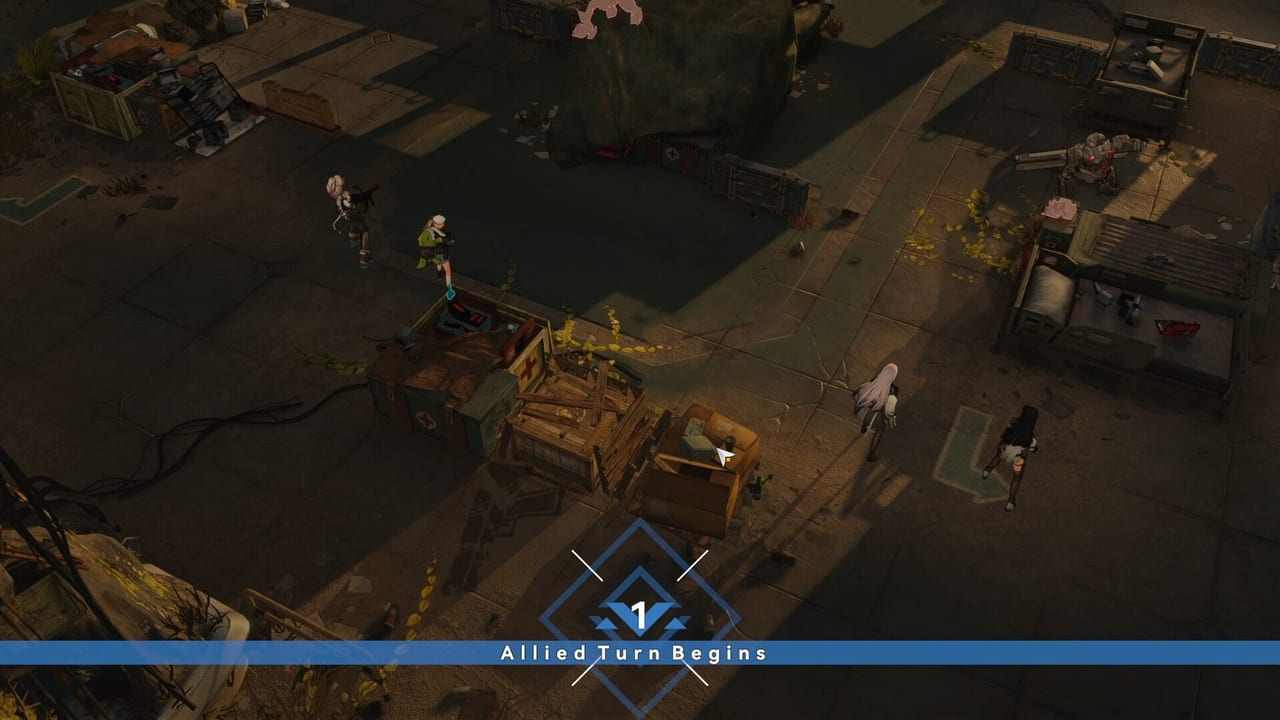
Girls’ Frontline 2: Exilium looks like a cover shooter and plays like a tactical RPG with the miss roll removed. If an attack is legal, it hits. Damage then runs through cover, Stability Index, ammo weakness, phase weakness, and whatever tiles occupy the floor. This page is the combat ruleset you need after Getting Started, before you blame the tier list for a failed story node.
Hits, cover, and line of sight
There is no random hit chance. You will not see an XCOM-style 95 percent shot fail. Position still matters because cover is a damage-reduction facing, not an evasion roll.
- Half-body cover you can vault: about 30 percent damage reduction, full attack freedom over the lip.
- Full-body cover and solid half-cover you cannot vault: about 35 percent damage reduction. Full-body blocks line of sight. Dolls attack around it with a leaning attack if the tile they lean into is empty.
- Destructible cover sits a little lower (about 20–25 percent) and can be deleted by cover-break skills or some area attacks.
Iron fences block movement and melee but still take ranged fire. Energy cover blocks ranged shots while leaving melee and movement open. Large bosses often cannot enter cover at all; they fake the bonus with a Stability passive instead.
Park your own Dolls on the correct face of a wall. A Sentinel standing “in cover” on the wrong side is just standing next to scenery.
Stability Index
Every unit has a Stability Index, shown as a shield number beside HP. While that number is above zero and the unit is in cover, it gains about 60 percent extra damage reduction on top of the cover bonus. Combined, a shielded target behind full cover can shrug off 90 percent of a naive shot. That is why early bosses look immortal.
Incoming hits chew Stability. At zero the unit enters Stability Collapse: the 60 percent bonus is gone until something restores the shield. Cover’s own 30–35 percent still applies from the covered facing.
Stability reduction does not apply when:
- The attacker is melee (Krolik, Ullrid, and similar Vanguards). Cover DR can still apply unless you also flank.
- The attack is a qualifying area skill. Some AoE also ignores cover DR if the blast is placed correctly.
- The attacker is on high ground (or perforated high ground that can see over the wall).
- The shot flanks the cover facing — you walked around the shield, not through it.
Phase and ammo weakness each add about 10 percent damage and extra Stability damage. Breaking a target is often more valuable than raw HP chip, because the next Doll in the turn order then hits a collapsed shield. Supports who strip Stability are doing DPS work even when the number on the skill is a debuff.
Confectance, classes, and ammo
Confectance Index is the skill resource. Basics and some passives refill it; ultimates and heavy actives spend it. A Doll who opens with a full bar (Tololo is the famous example) can ultimate on turn one. A Doll who needs two turns of basics is not weak; she is a different tempo.
Classes you will deploy:
- Sentinel — primary damage, usually the unit you feed attachments to.
- Support — heals, buffs, Stability break, tiles, or Action Support shots.
- Bulwark — front line, Shelter, damage redirect, cover tricks.
- Vanguard — mobility and melee or flank pressure.
Weapons are locked to a Doll’s gun type (AR, SMG, SG, SR, MG, and the rest). Attachments and calibration sit on the gun, not on the Doll. Duplicate Dolls become Vertebrae from V0 to V6. Keys modify skills. None of that replaces positioning. A V0 Qiongjiu who flanks will beat a V2 Qiongjiu who shoots a full-cover shield in the face. Build pages live under weapons and builds and team comps.
Phase tiles before Chiral Redundancy
Burn, Freeze, Electric, Corrosion, Hydro, and Physical tiles have always been part of map control. A Doll who “paints” a tile is setting a trap for whoever ends a turn there, and a teammate who shares that phase will often gain extra damage or a cheaper skill. Hydro teams damp tiles; Burn teams stack Overburn; Corrosion teams eat Stability. You do not need every phase on one account. You need one team whose tiles agree. Event bosses in Chiral Redundancy are built to punish a roster that only ever shoots Physical into a Freeze tile.
Tile Transformation (27 August 2026)
The Chiral Redundancy patch added Tile Transformation. When phase tiles overlap, they no longer simply replace each other.
- Monophase Fusion — two tiles of the same phase stack into a stronger tile. Burn plus Burn becomes Flashover. Freeze plus Freeze becomes Solidize. Electric plus Electric becomes Thunderstruck. Corrosion plus Corrosion becomes Withering. Hydro plus Hydro becomes Tidal Surge.
- Multiphase Fusion — two different phases create a named fusion tile that applies both weaknesses. The examples commanders actually search: Burn + Freeze = Smoldering Suspire, Burn + Corrosion = Venomfire. Other mixes include Scalding Vapors (Burn + Hydro), Crystalveil (Freeze + Hydro), Radiant Energy (Electric + Corrosion), Thunderpool (Electric + Hydro), and Toxic Quagmire (Corrosion + Hydro).
Amplified Resonance lets a fused tile upgrade again if you keep applying a component phase. Sunborn’s own demos walk Burn into Flashover II/III and Venomfire into higher fixed-damage steps. You do not need to memorise every number. You need to stop overwriting a teammate’s tile by accident, and you need one support who can drop the second colour on purpose.
Practice this on event maps, not on the first Supply node of the day. Farming stages are for Intelligence Puzzle efficiency; story and Gunsmoke maps are where fusion tiles win turns. If a boss still will not die after you out-level it, look at facing, Stability, and the floor before you spend Targeted Access Permissions. Gacha will not fix a flanked Bulwark. Pity rules, if you still want a specialist, are on gacha and pity.
A simple combat checklist
- Count enemy cover facings before you move.
- Assign one Doll to break Stability (AoE, melee, or a Support chip skill).
- Assign one Doll to walk the flank or the high tile.
- Spend Confectance when the shield is already down, not as the opener, unless the kit is built to open.
- If you own two phases, overlap them on purpose after 27 August 2026.
- If the stage is Gunsmoke, read Platoon and Gunsmoke for the score rules; the tile rules on this page still apply.
Combat in Exilium is a facing puzzle wearing a gacha coat. Learn the puzzle once and every later Doll, including OTs-14 now and Soppo on 17 September, plays on the same grid.
Frequently Asked Questions
Quick answers commanders actually search for.
Can attacks miss in Girls' Frontline 2?
No. There is no random hit chance. If the shot is legal, it hits. Cover and Stability reduce damage; they do not create a dodge roll.
How much damage does cover actually block?
About 30 percent on vaultable half-cover and about 35 percent on full-body cover. Stability Index adds roughly 60 percent more DR while the shield is up and the unit is in cover. Melee, some AoE, high ground, and flanks ignore the Stability portion.
What is Tile Transformation?
A Chiral Redundancy system (27 August 2026). Overlapping same-phase tiles Monophase-fuse; different phases Multiphase-fuse. Burn plus Freeze becomes Smoldering Suspire; Burn plus Corrosion becomes Venomfire. Event notes are on Chiral Redundancy.
What is Confectance Index?
The skill resource that fuels ultimates and many active skills. It refills from basics, passives, and some Supports. It is not Stability and it is not HP.
Why does a higher-level squad still bounce off a boss?
You are shooting a covered Stability shield from the front. Flank, break the shield, use melee or AoE, or paint a phase tile. If the roster itself is the problem, compare kits on team comps rather than dumping more Combat Reports.